



Kid Talking Flash Cards Machine – One Card Reader, Six Different Shelves, and the Version Each One Needs
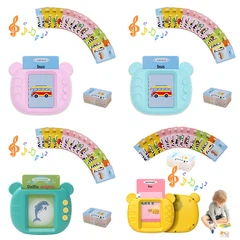
Details: The Kid Talking Flash Cards Machine is a handheld card reader for young children: a card goes into the slot, the machine says the word, and the child moves on to the next one. The standard build ships with 112 cards arranged across 14 themes and 224 words, three function buttons for on/off, repeat and volume, a 28 mm speaker, 16 MB of onboard memory and a 200 mAh cell charged over USB. It measures 99 × 86 × 21 mm and weighs 285 g, so a four-year-old can hold it in one hand. What makes it commercially interesting is not the hardware but the fact that the identical unit can be dressed for six completely different shelves – a toy aisle, a language school, a preschool store room, a speech-therapy catalogue, a gift programme and an online listing – without a single change to the tooling. The standard production run starts at 1,000 pcs, with smaller trial batches available on request.
Why the Same Card Reader Sells Differently in Six Different Aisles
A card reader is a simple object, which is exactly why it travels so well between channels. The child performs one action – seat a card – and gets one clear result: a word, pronounced properly, on demand. That loop is short enough for a two-year-old to learn in a minute and useful enough for a language teacher to build a lesson around. The same thirty seconds of play answers a toy buyer's question about engagement and a school buyer's question about repetition, and those two buyers rarely want the same box.
Everything that separates one channel version from another sits on the content and packaging side. The card set and its theme spread, the language pairing, the wording on the gift box, the accessory bundle and the pack format – single units for retail, multi-unit cartons for institutions – can all be changed between runs. Nothing in that list requires a new mould, a new board or a fresh type test, which is what makes a channel plan practical for an importer carrying several accounts at once.
Getting the channel call right is worth more than getting the price down. A broad fourteen-theme deck that sits in a language school looks unfocused next to a single-purpose product, while a narrow one-theme deck in a gift fixture looks thin and cannot justify its shelf space. The version a buyer orders should be decided from the fixture backwards: who is standing in front of it, what they came in to solve, and what the box has to say in the two seconds before they pick it up.
A short test in the target channel answers that faster than any internal discussion. Two hundred to five hundred units in one account will tell you whether the theme spread is right, whether the language pairing is the one the market actually studies, and whether the box copy survives contact with a real shelf. The winning version then becomes the template for the full run, and the rejected one disappears for the price of a small batch.
Freight is the quiet variable in any channel plan. A shipping carton of forty readers measures 29.5 × 27.5 × 40.5 cm and weighs 12.5 kg gross – light enough for one person to lift by hand, dense enough that a pallet fills predictably when a container is being split between two accounts. Retail channels generally want that carton broken down store by store; institutional buyers usually prefer it left intact and delivered to a single address. Neither preference touches the machine, but both change what is printed on the outside of the box, and that marking is decided late in the process rather than at the start. Buyers who know how their shipment will be split before production begins tend to avoid a handling charge at the destination port.
Kid Talking Flash Cards Machine – Channel Configuration Sheet (FC 001)
| Kid Talking Flash Cards Machine – What You Can Specify (FC 001) | |
| Item | Kid Talking Flash Cards Machine / FC 001 |
| Product Definition | Handheld card reader: seat a card, hear the word; one action, one result, no screen |
| Card Library | 112 cards across 14 themes, covering 224 words; theme spread and card artwork set by the buyer |
| Language Options | Eight pairings available: English, Chinese-English, English-Spanish, English-French, English-Arabic, English-German, English-Japanese, English-Korean |
| Controls | Three buttons – on/off, repeat, volume |
| Memory & Audio | 16 MB onboard memory; 28 mm speaker driver tuned for single-word clarity |
| Cell | 200 mAh lithium, rechargeable |
| Charging | USB inlet; no dock, no base station, no cable to a wall socket |
| Dimensions | 99 × 86 × 21 mm body |
| Net Weight | 285 g including the reader |
| Retail Box | 130 × 95 × 45 mm gift carton, artwork and copy set per market |
| Shipping Carton | 40 pcs per carton; 29.5 × 27.5 × 40.5 cm |
| Gross Weight | 12.5 kg per carton |
| Compliance | CE, UKCA, FCC, RoHS and CPC; ASTM F963 and EN71 documentation on request |
| Order Quantity | 1,000 pcs for a standard run; 200–500 units for a channel test |
Ask for the channel pack and it arrives in one go: unit pricing tiers, sample and trial terms, the card artwork template, the word-list sheet for recording and the carton configuration for your destination. Send the channel, the language pairing and the quantity through the enquiry form or straight to the export desk, and the material reaches your inbox inside one working day. The wider range of talking-card and audio products is listed here: https://www.kidsoundbook.com/products
Six Channel Versions You Can Build From One Unit
Details: These are the six versions buyers actually order, each one assembled from the same reader with a different deck, box and pack format. Choose the version first and the specification list writes itself.
The General Retail Version – Fourteen Themes in One Box
The default build: the full 112-card library across all 14 themes, packed in the 130 × 95 × 45 mm gift carton and aimed at a broad parent audience. It is the version that works when the buyer does not yet know who their customer is, and the one most often reordered because it needs no explanation at the shelf.
The Language-Pair Version – Built Around One Market
One of the eight available pairings is chosen and the whole deck is voiced to match, so the product stops being a general vocabulary toy and becomes a bilingual learning tool with a clear claim on the box. Buyers in markets where children start a second language early order this version almost exclusively, and it is the easiest upgrade to sell at a higher price.
The Classroom Version – Multiplies, Not Boxes
Institutional orders care about pack format before they care about anything else. The reader travels 40 to a carton at 12.5 kg gross, which keeps handling manageable, and the deck can be narrowed to the themes a specific curriculum uses so that each unit arrives teaching the unit the class is on.
The Speech and Special-Education Version – Repeat Is the Feature
For clinics, therapists and specialist suppliers, the repeat button moves from a convenience to the point of the product: the same word comes back as many times as the child needs, without an adult having to reload anything. Decks for this channel lean on single words, calm artwork and slow pacing rather than on breadth.
The Travel and Gift Version – Small Box, No Setup
At 285 g with a 130 × 95 × 45 mm box, the reader suits gift and travel programmes where the unit has to be carried home, handed over, and used within a minute of being unboxed. There is no account, no pairing and no download, so it behaves the same in a hotel room as it does in a living room.
The Online Version – Built for a Listing, Not a Shelf
Marketplace and direct-to-consumer sellers need one language claim presented clearly, a box that survives a courier, and photographs that show the card going into the slot. This version keeps the accessory count deliberately low so the listing images stay clean, and puts the whole story on the front of the carton.

Season Two – Change the Deck, Keep the Machine
Once a channel version has found its audience, the next order is usually the same reader with a different card set: a seasonal theme, a second language pairing, or a pack built around the next school term. The hardware and its compliance file stay where they are, so the new line arrives with the reviews and the listing history of the first one still attached to it.
Six Kinds of Buyer Standing in Front of That Shelf
The version a buyer needs is usually visible in the first email they send. These are the six profiles this reader is ordered by, and the question each one opens with.
Buying Window and Channel – When Each Version Sells
| Channel Calendar – Kid Talking Flash Cards Machine FC 001 | ||
| Buying Window | Channel It Serves | Version to Have Ready |
| Fourth quarter | Toy chains, gift retail, online | General retail version in a gift carton, plus one premium language-pair edition |
| January to March | Education resellers, tutoring chains | Language-pair deck matched to the term ahead, teacher-facing box copy |
| Back to school | Preschool and school suppliers | Classroom version in multi-unit cartons, decks narrowed to a curriculum unit |
| Spring gifting | Gift and promotional distributors | Compact gift version with room for a branded insert card |
| Ramadan and Eid (MENA) | Regional retail and gifting | Localised deck and carton copy, stock landed well ahead of the holiday |
| Summer travel | Travel retail, holiday programmes | Travel and gift version – small box, no setup, no network |
| Year-round clinician orders | Speech and special-education suppliers | Single-word deck with the repeat function positioned as the lead feature |
Two rules keep a channel plan from turning into six half-finished projects. First, one deck per order – mixing themes across a single production run confuses the box copy and makes the listing harder to write; second, confirm the language pairing before the artwork, because the words decide what the illustrations have to show. Get those two right and a second channel costs a content build rather than a new product.
Why a Channel-Ready Unit Beats a Cheaper Single-Version One
A reader that only exists in one version has one route to market. Everything below follows from changing that, and each point shows up in the buyer's own numbers rather than in a specification.
| Comparison – A Channel-Configurable Reader Against Fixed-Content Learning Aids | ||
| FC 001 channel build | App-based learning tablet / loose printed cards | |
| What the child does | Seats a card, hears the word, repeats if needed | Swipes a menu, or asks an adult to read aloud |
| Number of channels it fits | Six, from toy aisle to speech clinic | Usually one positioning, decided at launch |
| Language coverage | Eight pairings, chosen per order | Whatever the app store offers, often fixed |
| Setup needed | None – 200 mAh cell, USB charging, no account | Install, log in, occasional update |
| Group use in a classroom | 40 units per carton, each independent | One screen shared between children |
| Adding a second market | A new deck and carton copy on the same reader | A new product line or a new app |
| Screen time | None | Continuous by design |
The claim is kept deliberately narrow: this is a talking card reader with 112 cards, 224 words, three buttons and no screen, and its advantage to a distributor is that the version, the language and the box are decisions rather than fixed features. It is not sold as a teaching system, and it does not need an app, a subscription or a network to work in any of the six channels above.
From Channel Decision to Sealed Carton – Eight Steps
What a first order looks like once the channel is chosen. The hardware steps are short and repeatable; the content steps are where the launch is won, and they are the ones worth planning backwards from your season.
| Order Path – Channel Version to Export Carton | ||
| Step | What Is Decided | What We Need From You |
| 1. Channel selection | The six versions are matched against your accounts and the box copy is drafted accordingly | Target channel, destination country, target price |
| 2. Theme spread | Which of the 14 themes make the deck, and how many cards each one carries | Theme list, or the curriculum unit to follow |
| 3. Language pairing | One of the eight pairings is fixed, along with accent and pacing of the recording | Language pair, dialect preference, narrator tone |
| 4. Word list and artwork | Final word list, card illustration style and card size are approved together | Word list or a written brief, plus brand assets |
| 5. Recording | Voicing, editing and level matching, checked for single-word clarity on the 28 mm driver | Pronunciation notes and any named characters |
| 6. Box and bundle | Carton artwork, insert cards and accessories are set for the channel | Box copy, logo file, importer details |
| 7. Sample unit | A working reader loaded with your deck is shipped for approval | Sign-off on words, card artwork and carton |
| 8. Run and dispatch | Production, in-line checks, document pack assembled and 40-unit cartons marked | Quantity, delivery window, carton markings |
The single item buyers most often leave too late is step four. The illustrations have to match the word list exactly, and a change to one of them after recording means redoing the other, so it is worth signing both off together rather than approving a word list and hoping the artwork follows. Buyers who settle the deck and the artwork in the same review usually take their second channel from order to shipping in noticeably less time.
Questions That Come Up Before a Channel Order Is Placed
Q1: Can one order supply a toy account and a school account at the same time?
Yes, and it is a common way to spread the fixed cost of a first run. The reader is the same in both cases, so the difference is the deck and the carton copy. Most buyers split the run cleanly – one theme spread and one carton design per account – and keep the two apart physically so that a warehouse or a fulfilment partner cannot mix them during receiving.
Q2: How many languages can be produced in a single order?
Eight pairings are available as standard – English on its own, and English paired with Chinese, Spanish, French, Arabic, German, Japanese or Korean – and the recording is produced per order, so a run can carry more than one of them as long as the packs stay separated. In practice buyers limit themselves to one or two pairings per shipment, because each one carries its own artwork and its own box copy.
Q3: What actually changes between those pairings?
Three things, and they should be decided together. The voiced word changes, the printed word on the card changes, and the accent of the narrator changes. The illustrations usually survive unchanged, which is why a second pairing is cheaper than a first – but in markets where a word has several everyday meanings, the picture may need adjusting so the child is not looking at one thing while hearing another.
Q4: What happens when the cards get worn?
Cards are consumables, and that is a commercial fact rather than a weakness. They are produced for each order, so a replacement deck or a fresh theme pack can be ordered on its own, without a new reader and without a new tooling spend. Distributors who plan a card-only reorder for the second season usually find it is the cheapest way to refresh a product that is already listed and reviewed.
Q5: What sort of use does the 200 mAh cell support?
The cell is sized for the way this product is actually used: short, repeated sessions of a few minutes rather than hours of continuous playback, topped up over a USB cable. Rather than quote a figure that will not match your market's habits, we would rather you run the sample the way your customers will – morning sessions, a car journey, a classroom rota – and confirm the runtime against real usage before the full order is placed.
Q6: Can we supply our own word list and our own card artwork?
Both, or either. Send a finished word list and artwork and we check them for print and playback before anything is produced; or brief the studio and the deck comes back written, illustrated and recorded to your market. You control how many themes are in the box, how many cards sit in each theme, and whether the deck leans towards vocabulary, phonics or everyday objects.
Q7: What is the smallest order, and how do we test a channel?
A standard run begins at 1,000 pcs, and a channel test can be placed from 200–500 units at a higher unit cost that is credited back against the first full order. Samples of one to five pieces ship within five working days of payment, and the sample charge is returned once the bulk order is confirmed. For a channel decision, we would rather you tested the version than tested the price.
Q8: Where is the unit made, and is the process open to inspection?
Moulding, board work, card printing, voice loading, assembly, testing and packing all take place at our Shenzhen site, which means a change of deck or language never depends on an outside supplier being told on time. Buyers can visit the plant or walk the lines over a live video call, and each carton can be followed back through the batch that produced it.
Where Every Channel Version Is Built
for children
The card reader described on this page is produced by a single manufacturer in Shenzhen that has been making children's audio equipment since 2010, and the reason a distributor can run six channel versions off one machine is that the deck and the device are built in the same building. Our work is OEM and ODM production for children's audio and interactive products – talking card readers, read-aloud picture books, story machines, projection units and musical toys – for importers, brand owners and retail groups across six continents.
The site covers 3,000 square metres, bringing moulding, PCB assembly, card printing, voice loading, acoustic tuning and final packing into one operation, worked by more than 100 engineers and operators. Every line runs to the same principle – Create with heart, ship with pride – with a signed inspection at each stage, so a finished reader and the deck that goes with it can both be traced to the batch they came from.

Compliance Files, Matched to the Market
Certificates
The document set is assembled per destination before a shipment is booked and travels with the batch it describes. Request it with your quotation and the papers arrive together, ready to hand to an importer, a marketplace or a customs broker without a second round of emails.

CE

RoHS

FCC

SEMTA
EMC

ISO
Hot Tags: kid talking flash cards machine – one card reader, six different shelves, and the version each one needs, China, suppliers, manufacturers, factory, customized, wholesale, bulk, quotation, made in China


