





CUSTOM PRODUCT DEVELOPMENT / RAINBOW SPHERE
Custom Rainbow Sphere Plush Toy Manufacturer
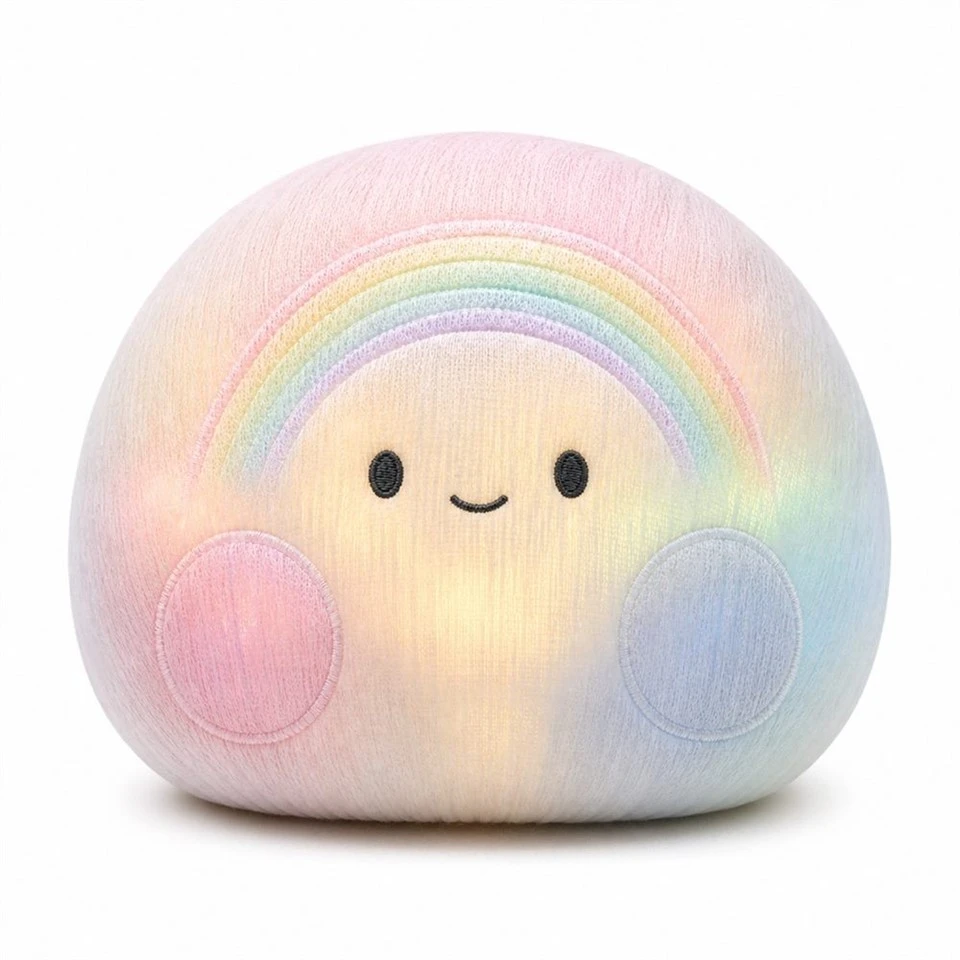
A striped sphere looks simple until a sample is placed on a table and slowly rotated. Then every panel junction, colour boundary and curve becomes visible. Our custom rainbow sphere plush toy program is built for technology brands and creative teams that need the soft body, optional electronics and production evidence developed as one controlled project.

Start with the roll test
Set the first prototype on a flat surface and turn it through a full rotation. A good rainbow sphere plush prototype should not collapse into an oval, rock on one overfilled point or hide a misaligned colour join underneath. This quick inspection gives buyers a shared vocabulary before fabric, embroidery or optional interaction features are approved.
The design problem is not "make it round"
A sphere is produced from curved textile panels, not from a rigid mould. Small differences in seam allowance, stretch direction and filling density change the finished profile. Instead of asking for perfect geometry, the brief should define the viewing distance, intended resting position, acceptable softness and which colour junction is the visual front. Those decisions are more useful than an isolated diameter.
For a custom plush manufacturer, the important question is repeatability. The approved sample becomes a set of controlled references: panel templates, seam landmarks, colour sequence, embroidery coordinates, filling target and inspection photographs. When these references agree, later production reviews can focus on measurable drift rather than personal taste.
Treat every colour boundary as a landmark
The segmented surface gives quality teams several fixed checkpoints. Inspect whether bands meet cleanly, whether one panel becomes unexpectedly narrow and whether the sequence remains consistent around the body. For OEM plush toy development, we recommend naming the panels in the technical pack so design, sewing and QC teams discuss the same location without relying on vague phrases such as "the bright side."

Choose fabric by behaviour, not only by a swatch
A colour card cannot show how pile direction changes under curved sewing. Two visually similar fabrics may stretch differently, reflect light differently or create different seam definition after filling. The sample review should therefore compare colour under neutral light, hand feel, pile recovery, seam visibility and how the material behaves when compressed for packaging.
Brands may adjust shade, texture and pile according to their audience, but the set must remain compatible across all panels. A single high-stretch colour can distort the sphere even when every pattern piece is cut correctly. Our OEM/ODM plush development review links fabric selection to the geometry instead of treating sourcing as a separate step.

Check the face from three distances
A small embroidered expression can feel balanced close up yet disappear in a room setting. Review the face at arm's length, across a meeting table and in a phone photograph. The eyes, mouth and surrounding colour field should remain calm and legible. This is especially useful when the custom character plush will support branding, guided audio or a screen-free user experience.
Decide what the product does before choosing electronics
The images define an exterior concept; they do not prove that a voice module, sensor, wireless connection or AI service is already inside. A technology brief should begin with the user action and the expected response. Does a squeeze start a fixed sound? Does a button change modes? Is a microphone required? How does the product stop, sleep or recover after an error?
Only after that interaction map is agreed should the engineering team compare an offline sound IC, another MCU or an ESP32 platform candidate. Memory, audio codec, microphone placement, speaker direction, power draw, update method, privacy and destination-market requirements decide the architecture. Familiarity with one chip is not a substitute for a product specification.
Reserve an internal quiet zone
Curved seams, filling and embroidered areas compete with any internal hardware. During electronic integration, the pattern should reserve a stable zone for the enclosure, wiring and service access without creating a visible hard edge. A paper volume mock-up inside the sewn shell often reveals conflicts earlier than a finished PCB, saving a late pattern revision.

Audio quality changes after the module enters the plush
A speaker that sounds clear on a bench can lose definition behind fabric and filling. Test the assembled sample in the positions people will actually use: resting on a desk, held against the body and placed near soft furnishings. Listen for muffling, vibration, sharp peaks and volume inconsistency as the sphere turns.
If voice pickup is planned, microphone clearance and acoustic isolation need the same attention. The R&D team should record the test setup, firmware version, audio file and pass criteria. This turns "sounds good" into evidence that another sample can reproduce, while leaving final feature choices adjustable to the client's approved requirements.

Let the colour layout guide interaction
The multi-panel surface can support intuitive orientation without adding printed instructions. A chosen band may identify the visual front, a control area or a removable service point, provided the final construction confirms it. In an AI plush toy concept, visual cues should reduce setup friction; they should never imply unverified functions merely because an image looks technological.
Prototype in decision-sized steps
A productive sampling plan separates questions. The first round may focus on silhouette and panel order. The next can lock fabric, expression and filling. Electronics, firmware, audio and packaging can then be evaluated against a stable soft-goods shell. Combining every open decision in one expensive sample makes it difficult to understand why the result changed.
Each review should end with a short decision log: accepted, revise, optional or still open. Mark corrections on photographs and include a unit of measurement where appropriate. This practical discipline is more valuable to an R&D product development team than an attractive presentation with no traceable approval points.
Inspect the seam junction under gentle pressure
Press around the centre where several coloured panels approach one another. Look for puckering, a hard knot, uneven tension or filling migration. This area often reveals whether the pattern and sewing sequence are working together. For custom manufacturing, the correction must be translated into a pattern or process instruction-not left as "make it smoother."

Plan packaging with the recovery test
A soft sphere may be compressed to improve carton efficiency, but compression can rotate filling, crease pile or flatten one side. The packaging trial should record compression time, unpacking method and recovery interval, then compare the result with the approved sample. If shape recovery depends on vigorous reshaping, the retail or end-user experience may not match the presentation sample.
Packaging decisions also affect accessories, electronics and instructions. A connected version may require protection around a control or charging area; a conventional soft version may prioritize shape retention and clean presentation. The packaging brief should follow the actual product architecture rather than a generic plush box.

Measure after the sample has rested
Dimensions taken immediately after unpacking can be misleading. Allow the sample to recover, place it in the agreed resting orientation and measure the same landmarks each time. A plush toy quality inspection should combine overall dimensions with photographs of roundness, face position and panel width so buyers can understand both the number and the visible result.
Use a comparison sample, not a vague adjective
When a buyer asks for a firmer body, warmer colour or cleaner curve, attach the comment to a physical or photographed reference. Compare the proposed change with the current sample under the same light and from the same angle. Then record one controlled adjustment: revise a named panel, change filling in a defined zone or move embroidery relative to a seam landmark. This method keeps creative feedback alive while making it executable. It also prevents several teams from interpreting words such as "premium," "cute" or "balanced" in different ways. For international plush toy sourcing, a shared comparison reference shortens discussion and protects the design intent across time zones.
Build the production file around evidence
Before mass production, the file should contain approved artwork, pattern revision, fabric references, embroidery program, colour order, filling instruction, optional electronics specification, firmware release, packaging method and inspection points. Items that remain optional should be labelled as options, not silently included in the baseline quotation.
This approach supports clearer commercial planning. Sampling cost, lead time and MOQ depend on the chosen materials, construction, electronics, testing and order quantity. A responsible quotation identifies those variables and states what is included. It does not turn an early visual concept into an unsupported promise.
Use the side view to expose drift
Front images can hide a flattened back or an offset face. Rotate the sample and compare the highest point, widest point and resting base from both sides. The aim is not mathematical perfection; it is a controlled silhouette that remains intentional. This side-view habit gives an OEM/ODM buyer faster feedback than broad comments about cuteness or quality.

Quality control should follow the order of failure
Incoming inspection checks fabric identity, shade and accessory specifications before cutting. In-process inspection checks panel sequence, seam allowance, embroidery placement and any prepared hardware pocket. Final inspection reviews appearance, function, packaging and the approved test plan. The sequence matters because a late inspection cannot economically repair an early material or cutting error.
For a smart version, functional QC must also identify the software and hardware revision. Audio files, language packs, activation behaviour, power management and connectivity settings can change while the exterior remains identical. Traceability keeps a visually correct unit from being mistaken for a functionally approved one.

Separate visible design from hidden architecture
The same rainbow exterior can support a conventional plush, a fixed-audio product or a connected companion, but each route changes weight, service access, power, privacy and testing. During smart plush toy engineering, buyers should approve the exterior and the internal architecture as linked documents. That keeps optional technology flexible without obscuring cost or compliance decisions.
Six decisions that change the quotation
1. Surface construction. A buyer should decide whether the coloured bands are separate sewn panels, printed artwork or another approved technique. The choice changes seam visibility, minimum detail size, colour control and sampling effort. For this rounded concept, sewn segmentation gives tangible structure but asks more from pattern accuracy. Printing may reduce panel count yet creates a different hand feel and durability discussion. The quotation should name the intended construction instead of treating every visual route as equivalent.
2. Expression method. Embroidery, applique and printed details behave differently on a filled curve. Embroidery offers a clean, durable finish but its backing and stitch density can stiffen a small area. The face should therefore be sampled on the actual fabric and filled shell, not approved only as flat artwork. Specify thread colour, line weight, position landmarks and an acceptable visual tolerance that can be checked without guessing.
3. Filling character. "Soft" is not a single specification. A display object may need enough body to hold a round profile, while a comfort-focused item may need more give. Ask the sample team to compare hand compression, recovery, weight distribution and the way the base settles. When electronics are optional, reserve a separate weight and balance review because a module can shift the centre of gravity even if the exterior pattern does not change.
4. Access and service. If the final project includes replaceable batteries, charging, a removable module or a reset control, service access must be designed with the soft body. The location affects seam direction, closure choice, child access, visual cleanliness and packaging. It should be evaluated against the intended age grade and destination-market requirements. An access solution drawn after the exterior is frozen often forces a visible compromise or another prototype round.
A useful buyer brief fits on one page
Send the target user, intended market, reference artwork, preferred scale, colour priorities, interaction flow, languages, connectivity preference, content ownership, quantity range, packaging direction and target launch window. Highlight what is fixed and what the factory may propose. The document does not need every answer; it needs enough clarity to identify the next experiment.
For visual updates and prototype details, buyers may follow our plush development visuals on Instagram or visit the project video channel. These account links show broader development activity and are not presented as proof of functions in this specific concept.
End with an approval photograph, not a memory
At the final sample review, capture the approved front, both sides, top and resting base under consistent light. Include close-ups of colour junctions and expression placement. These images become practical references for sewing, assembly and final QC. A controlled rainbow sphere plush production program should be understandable to someone who was not present in the design meeting.

Questions buyers should settle before quotation
Does the pictured concept include AI electronics? No assumption should be made from appearance. Electronics, firmware, voice, connectivity and sensors are configurable project options that must be defined and tested.
Can the colours, expression and size be changed? Yes. They can be developed around the client's artwork and market brief, subject to sampling, material behaviour and an approved specification.
What makes the first sample useful? It should answer a small set of named questions-such as roundness, panel order and face position-and show which choices remain open.
What should a technology brand provide? A concise user scenario, visual priorities, interaction map, market, packaging direction and expected quantity range give design and engineering teams a practical starting point.
Turn the sphere into a testable product brief
The next step is not to select every feature. It is to agree on the visual front, the most important user moment and the evidence needed from the first prototype. From there, XDT can review an OEM/ODM development route covering the soft body, optional electronics, firmware, audio, testing and production planning.
Hot Tags: rainbow sphere plush toy oem development, China, suppliers, manufacturers, factory, customized, wholesale, bulk, quotation, made in China


