













Custom AI Cat Plush Toy Manufacturer
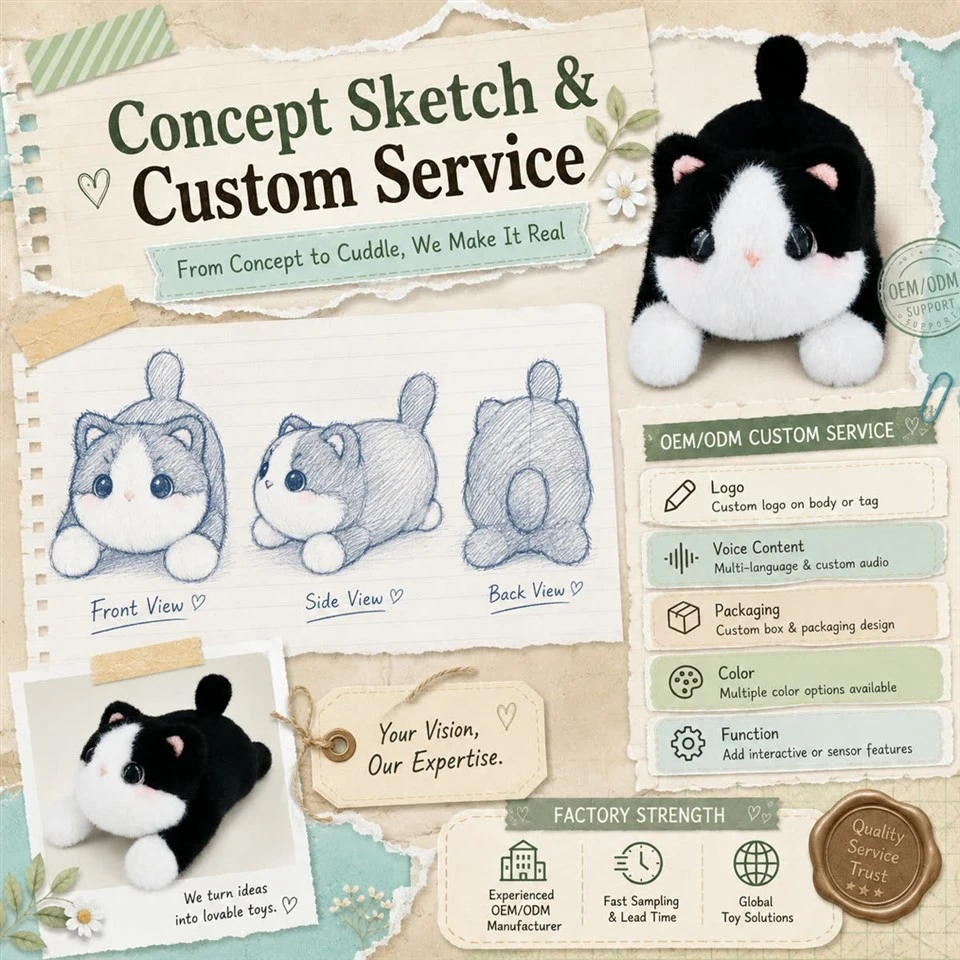
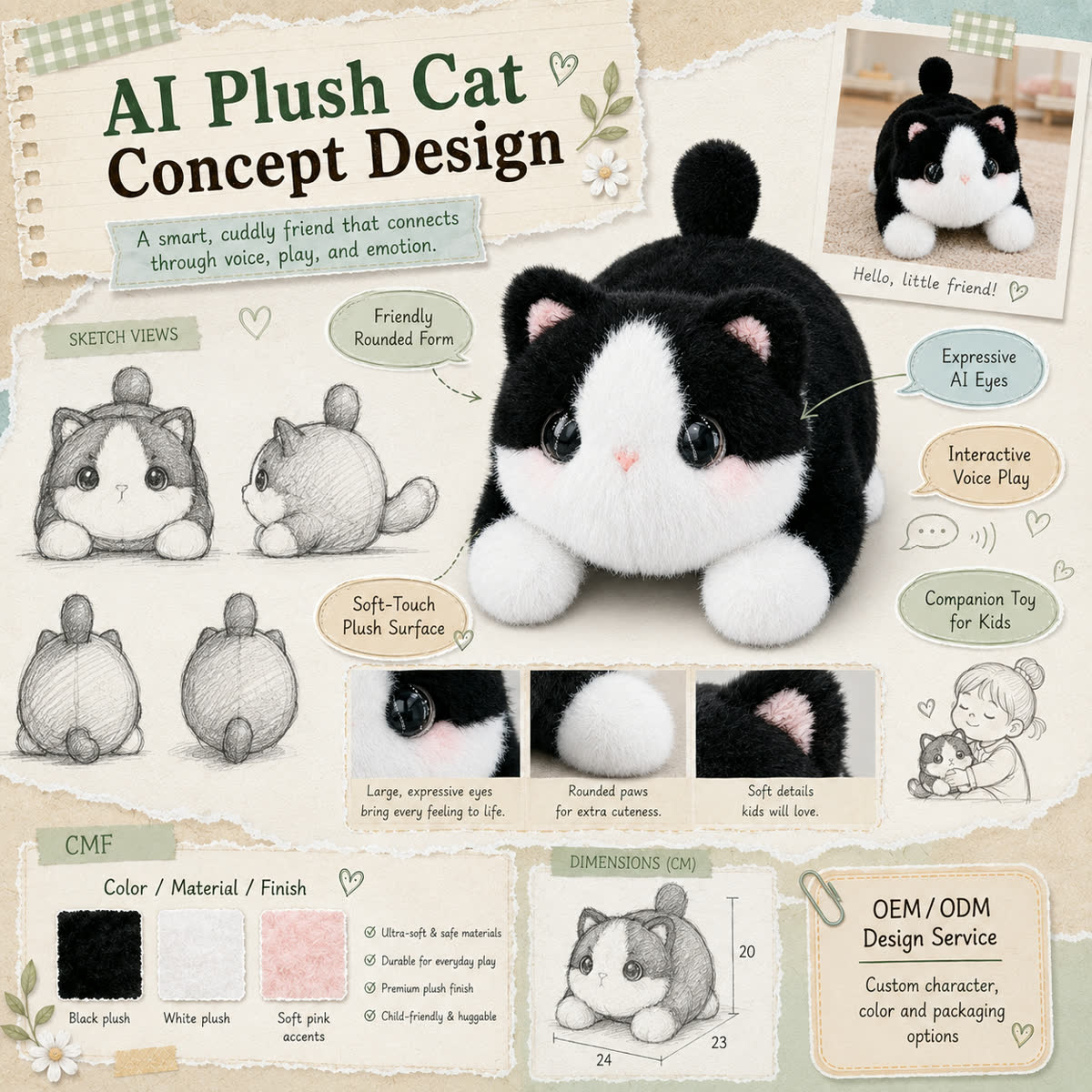
A low, rounded body, broad white cheeks, glossy eyes and an upright tail give this AI cat plush toy concept a recognizable personality. Xinditai can discuss the character, soft-goods construction and proposed electronic experience as one OEM/ODM project. The supplied visuals are development references. Final dimensions, functions, materials and commercial terms require an agreed specification and approved samples.
Discuss your project directly with Joy: WhatsApp +86 13691793052; E-mail xdt05@dtdianzi.com.

A Cat Character That Survives the Move From Artwork to Sample
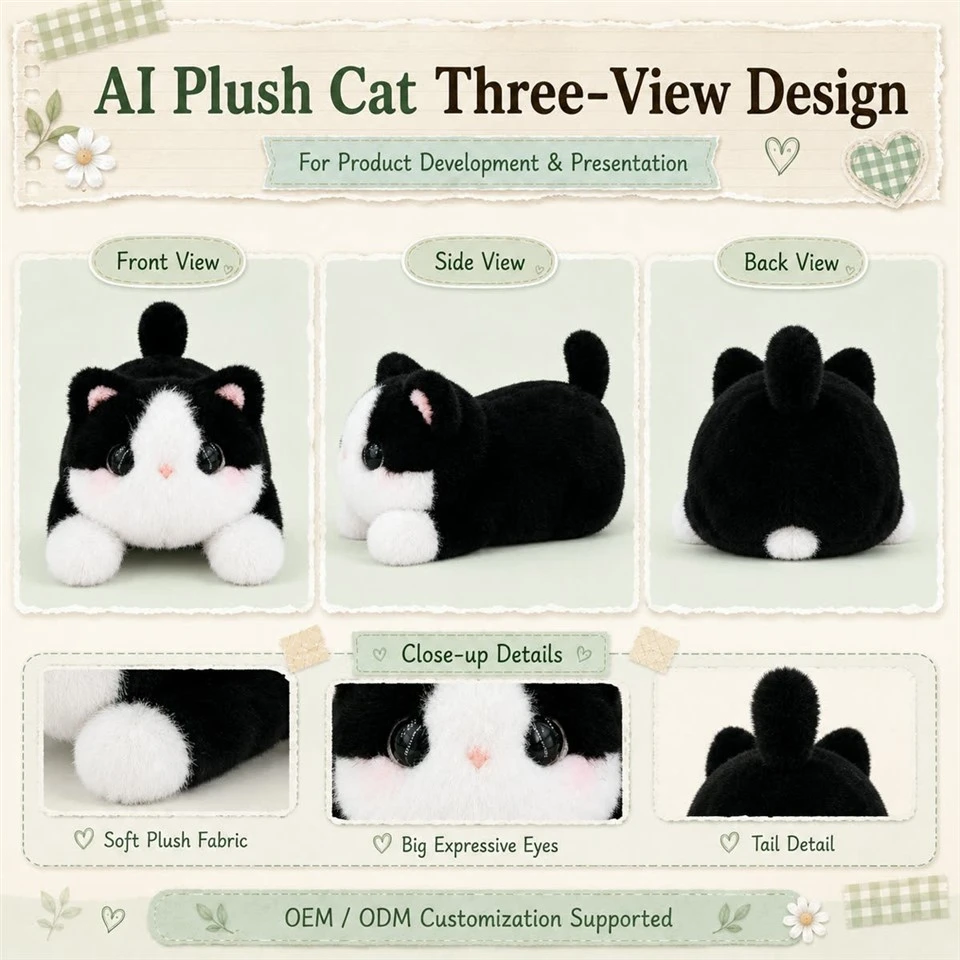
The broad white blaze, rounded cheeks and small pink nose give this custom AI cat plush toy a clear identity. Its low body and upright tail create a compact companion rather than a standing animal. Those details deserve a place in the specification: a face that looks balanced in a rendering can change when the pile is brushed, the head is stuffed or the camera moves to one side.
Start the appearance review with photographs at child eye level. Check whether the white blaze stays centered between the eyes, whether both ears remain visible and whether the front paws rest evenly. Ask for the same views after handling and packing. A consistent silhouette makes later decisions about voice modules, packaging windows and branded colorways much easier.
Choose the Interaction Route Before Pricing Electronics
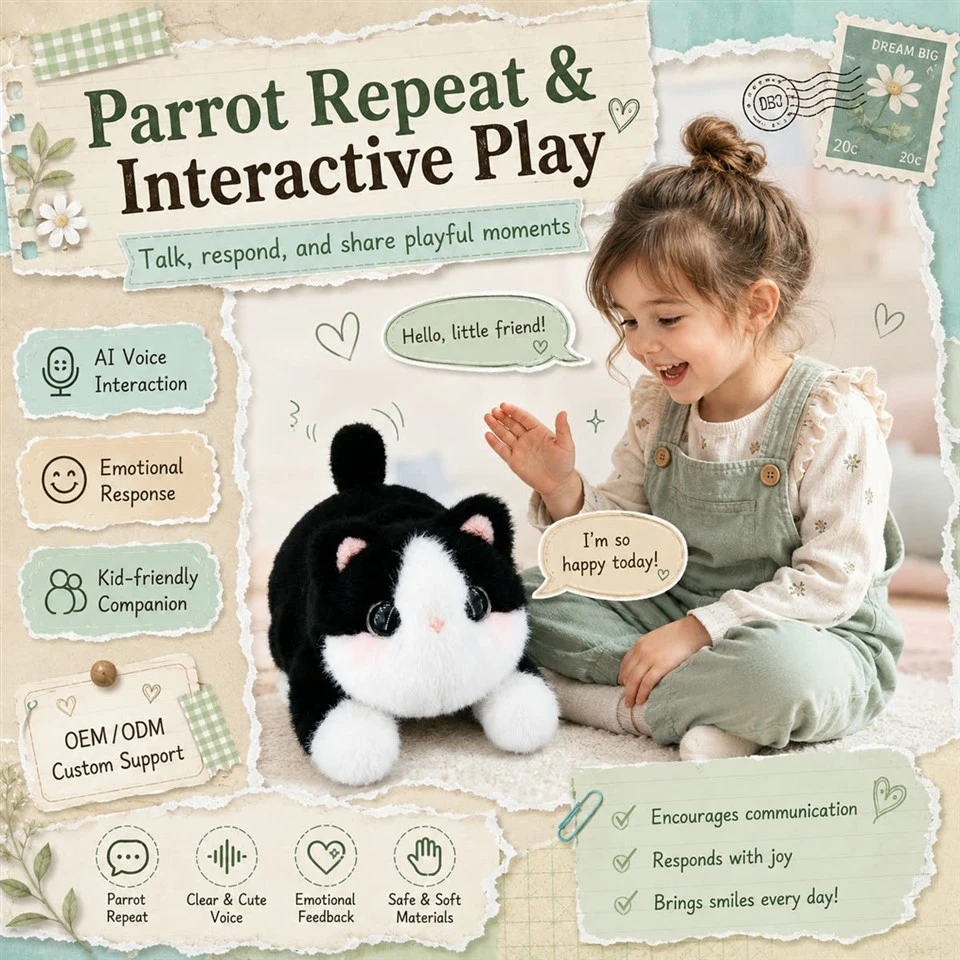
A talking cat can describe several different products. One repeats recorded speech, another plays fixed responses, and a connected version may send requests to a dialogue service. These routes have different content, power and support requirements. An AI plush toy manufacturer needs the intended behavior before selecting components or quoting development.

Write one example exchange in full. State how the child starts it, what the cat hears, how it responds and how the exchange ends. For a repeat mode, define recording length and playback timing. For dialogue, identify the language, connection method and response boundaries. The illustrations show possible directions; they do not confirm a finished electronic configuration.
A Commercial Brief That Makes Quotation Useful
Share the destination market, intended age group, quantity estimate, target retail position and preferred packaging. Add the desired language and a short description of the play routine. If the project includes an app or cloud dialogue, identify who owns accounts, content updates and ongoing service costs. Those responsibilities affect the practical scope as much as fabric and electronics.
Separate required launch functions from possible later additions. For example, a local repeat mode and touch greeting might form the first sample, while connected conversation remains a separate evaluation. Ask for the cost and schedule assumptions behind each proposal. Do not compare two quotations until their included tooling, content, sample stages, packaging and testing responsibilities describe the same scope.

Make the First Minute Understandable
The first interaction should be easy to demonstrate without a phone tutorial. A child might touch a marked area, hear a short greeting and receive one clear invitation to speak. An adult should be able to stop the session immediately. Decide whether startup sound is necessary and whether a silent power-on option belongs in the brief.
Avoid asking one hidden control to perform too many actions. A long press, double press and repeated squeeze may look efficient on a circuit diagram while remaining difficult to remember. Put a prototype in front of someone who has not read the instructions. Observe where they touch the cheeks, head and paws before deciding where the final control should sit.
Specify Expressive Eyes Without Assuming a Display
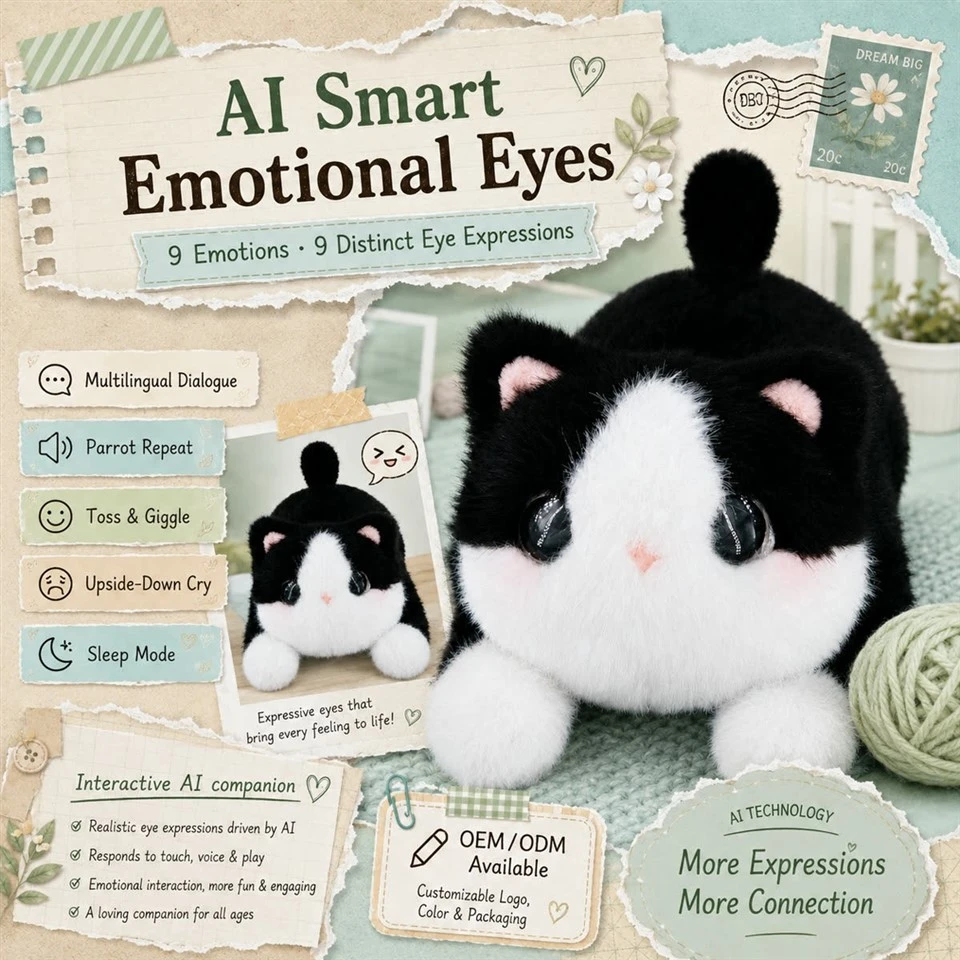
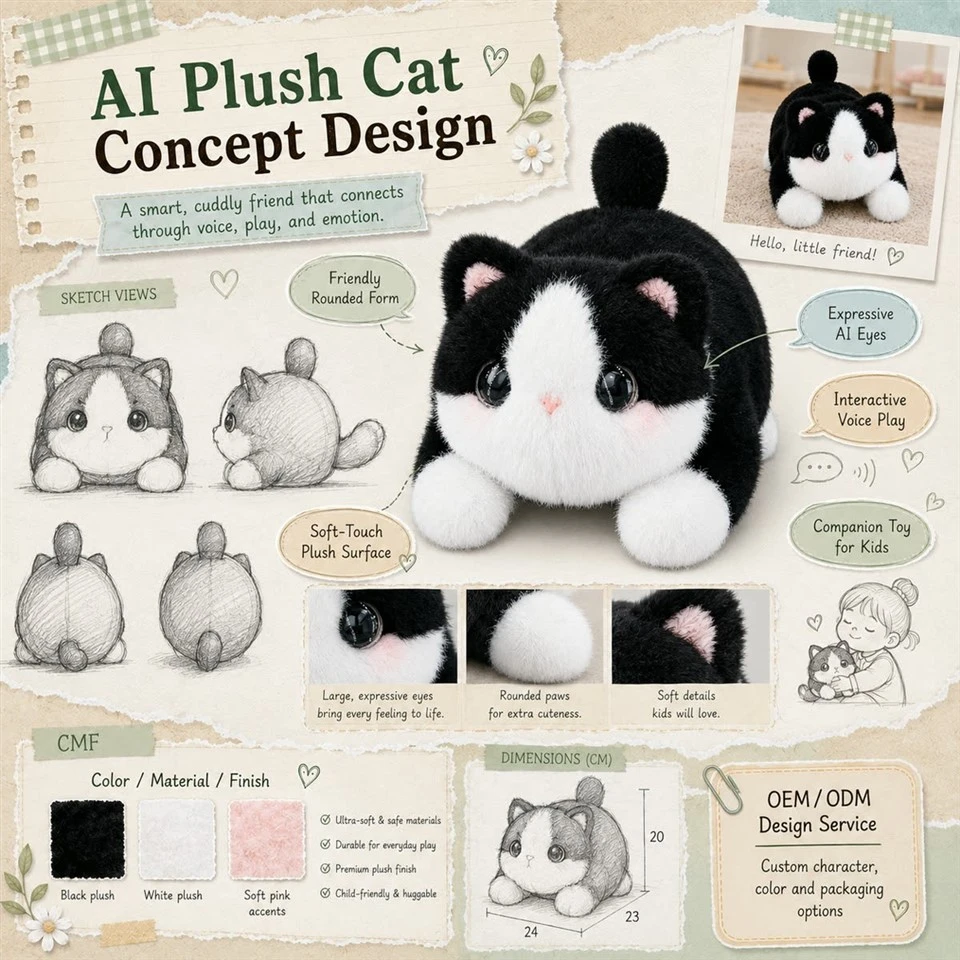
The concept boards emphasize large glossy eyes and several possible expressions. Buyers should distinguish the visible eye treatment from an electronic expression system. A fixed eye, printed insert and illuminated display each changes weight, softness, assembly and power use. The choice should follow the required experience rather than the language printed on a concept poster.

For electronic eyes, request an expression sheet with named states and actual transitions. A ready expression should be distinct from listening, processing, low battery and sleep. Review the eyes through the final fabric and under ordinary room lighting. If an effect cannot be read from normal holding distance, adding more animation will rarely solve the underlying problem.
Audio Approval Belongs Inside the Plush
A speaker can sound clear on a workbench and become dull after installation. Approve the voice through the final shell at minimum, typical and maximum settings. Listen while the cat rests on a soft surface and while someone holds it against clothing. Decide whether the sound outlet can be covered during normal play and how the design should respond.
Keep a small reference audio set for every build: greeting, repeated speech, quiet phrase and shutdown prompt. Record the device state, volume and battery condition. This gives the buyer and factory a shared comparison after enclosure or fabric changes. Avoid describing loudness only as loud enough; the acceptance method should be practical and repeatable.

Treat Repeating Speech as Its Own Product Experience
A recordable plush cat can offer a useful play routine without continuous connectivity. Repeat mode still needs careful design. The microphone must capture the intended voice without immediately recording the speaker output. Playback should end cleanly, and the toy should provide a predictable pause before listening again.
Test short words, quiet speech, two people speaking together and a television in the room. Record which sounds trigger playback and which are ignored. If a voice effect is included, approve the actual audio files or processing behavior, not a written description such as cute voice. A funny demonstration should also remain pleasant after several minutes of repeated use.
Keep Softness Around the Internal Package
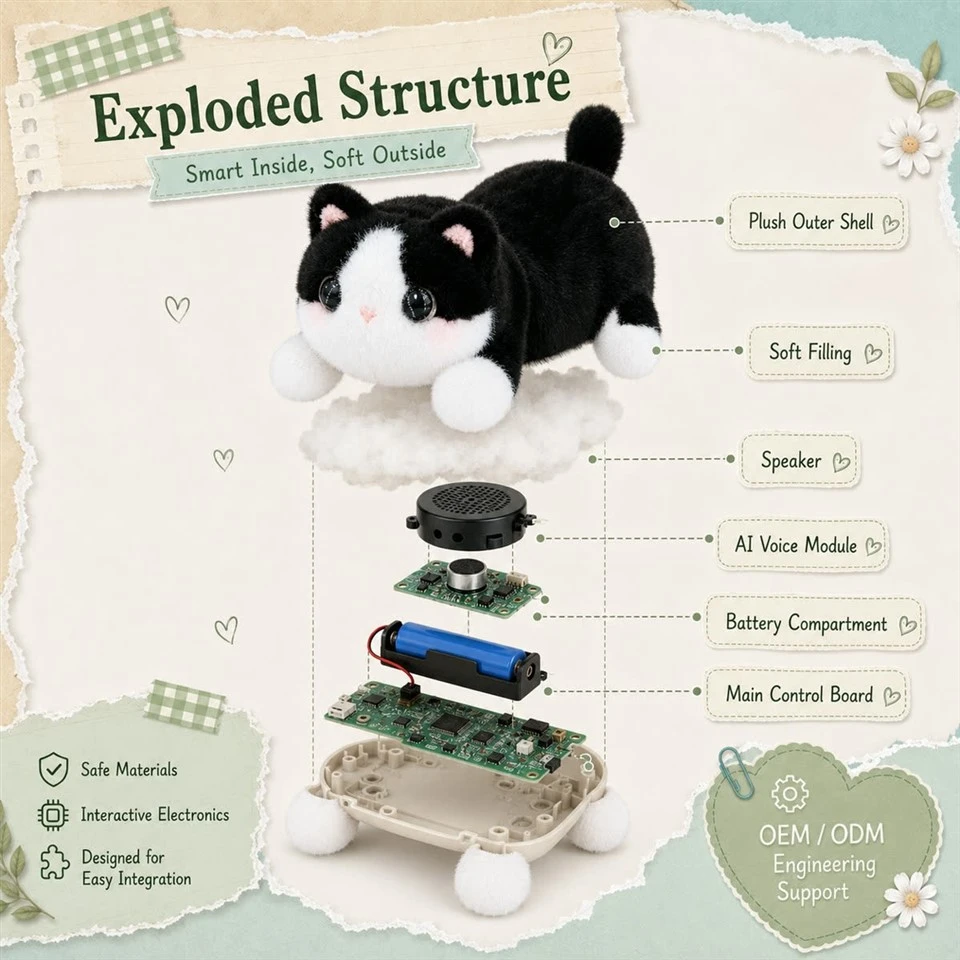
The illustrated exploded structure identifies a speaker, board and power arrangement as engineering discussion points. Their physical placement must be proven in a sewn sample. A rigid unit near the cheek can alter the cat's face; a heavy assembly can make the low body sag. Internal packaging therefore belongs in plush electronic integration from the beginning.

Review the toy while held, hugged and pressed against a tabletop. Feel the forehead, belly and paws with the final enclosure installed. Check that wires cannot drift toward a seam and that filling does not block the speaker. These ordinary handling checks reveal problems that a bench demonstration misses. Keep the enclosure reference and stuffing method with the approved sample.
Plan Care and Adult Access Early
The white cheeks and paws are likely to attract handling marks, so care instructions should be developed with the structure. Determine whether the electronic assembly stays enclosed or can be removed by an adult. A removable unit changes closure design, connector protection, reinsertion checks and the risk of filling moving into the pocket.
Only describe washing or cleaning methods that have been checked on the final construction. A material swatch surviving a wash does not prove that the completed toy, eye assembly or embroidered nose will do the same. Give families simple instructions that match the actual product, and include the care method in the sample review rather than leaving it until packaging artwork.

Resolve the Conflicting Size References
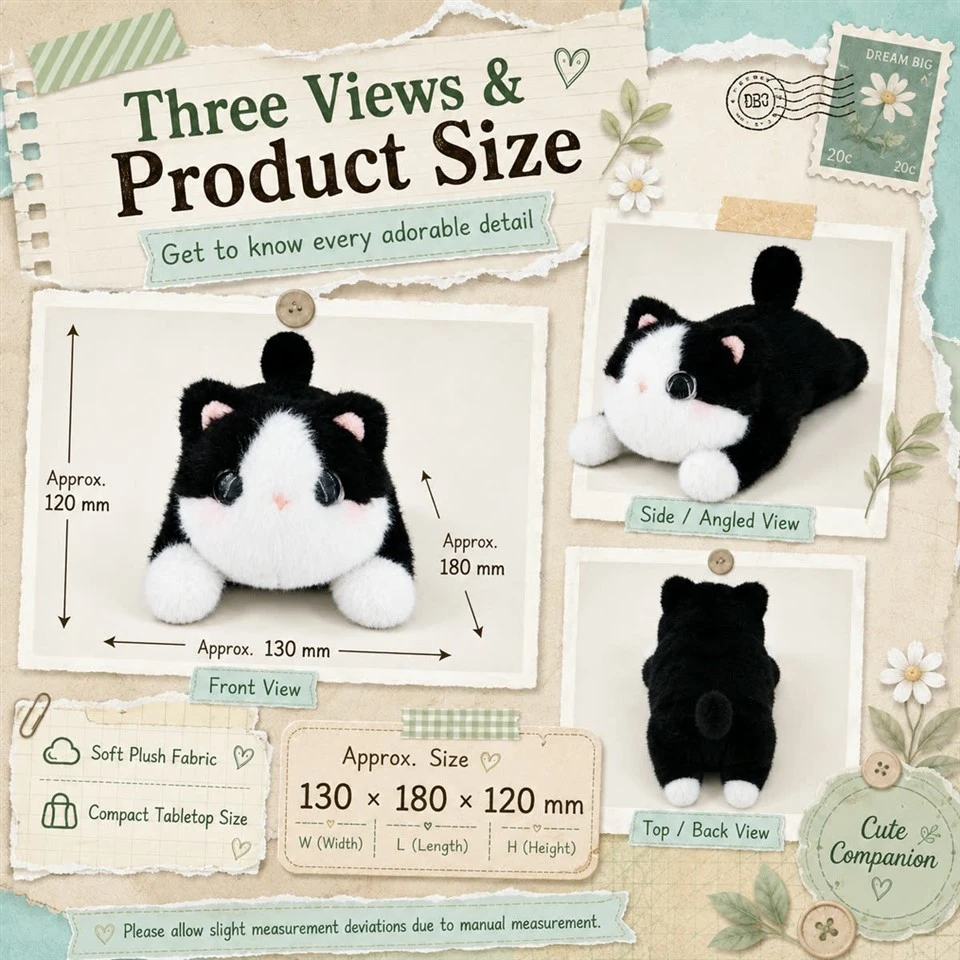
The supplied artwork includes different dimensional presentations. They should not be combined into one production claim. Select a target size, define measurement points and ask the pattern maker to confirm the resulting proportions. Tail height, body length and cheek width may refer to different boundaries, so even apparently similar measurements can describe different objects.
Place a ruler beside front and side samples and record where each measurement begins and ends. Include the tail only when the drawing explicitly says so. Then compare the internal unit at true scale. If electronics force the belly upward or separate the paws, revise the pattern before approving a retail carton. Dimensional clarity prevents avoidable packaging and freight revisions.
Build a Colorway Around the Face
Black and white provide strong contrast, but they also make alignment errors easy to see. Ask for a physical fabric and embroidery set before approving gray, brown or other private-label variants. The nose, ear lining and white facial panel need to remain readable as the body color changes. A digital recolor does not establish fabric availability or dye consistency.

Review swatches in daylight and warm indoor light. Brush the pile in both directions, compare adjoining panels and check whether backing shows through at the seams. For OEM/ODM plush customization, approve the full face assembly rather than isolated color chips. Keep an agreed reference so later batches can be compared under the same lighting and viewing conditions.
A Phone Connection Creates an Ownership Question
When a companion phone is proposed, decide what happens when the phone changes, the network drops or a family gives the toy to another person. Setup should have a clear endpoint. The parent needs to understand when the microphone is active, whether audio leaves the device and how any stored information can be reset.
An AI toy development project should compare an offline architecture with a connected alternative before choosing the platform. Microcontroller, connectivity and memory choices follow the required behavior. A named chip alone does not establish dialogue quality or product readiness. Request a working demonstration of the intended routine using representative language, acoustics and network conditions.
Develop Packaging Around the Real Unboxing
The gift presentation suggests a box, card and instructions, while another board proposes a handled retail carton. These are alternatives to discuss, not confirmed pack contents. The best format depends on the sales channel, target price and whether the buyer wants a gift reveal, shelf visibility or efficient distribution.
Pack an actual functional sample, leave it closed for the planned conditioning period, then open it as a customer would. Check the tail, ears, face pile and paw position. Confirm that printed inserts do not scratch the eyes and that ties do not compress the muzzle. If a cable is supplied, keep it secured separately and describe its use in clear adult instructions.
Turn the Sample Into a Repeatable Manufacturing Reference
A good-looking sample is only the start of a custom plush manufacturing program. Production needs stable pattern pieces, seam positions, filling distribution and inspection criteria. The cat's small nose and centered blaze are useful visual checkpoints; the upright tail and rounded paws need repeatable construction so the finished character retains its shape.

Ask the team to document the approved fabric, thread, stuffing approach, enclosure, audio version and firmware build. Identify which changes require another sample. A different speaker or denser filling may affect sound; a revised eye housing may affect facial symmetry. Keep these decisions together so the order specification describes the approved product rather than a collection of separate approvals.
Agree on Evidence Before the Pilot Order
At appearance approval, retain front and side photographs plus a physical reference. At functional approval, retain the interaction script and test results. Before a pilot run, freeze materials, internal assembly, software, content, labels and packaging. The purpose is to make deviations visible when several people or suppliers contribute to the same product.
Inspect multiple samples rather than treating one carefully prepared unit as proof of consistency. Compare the white blaze, ear angle, paw contact and sound response across them. Ask the relevant testing partner to review the complete configuration for the target market and age group. Component paperwork should support that review, while final claims remain tied to actual evidence.
Prepare a Cat-Specific Development Discussion
Send Joy the chosen artwork, the size reference you intend to use, your core interaction and the intended sales market. Include a short video or script showing the response you expect. That evidence helps turn an attractive cat into a measurable OEM plush toy project. Review the face, handling feel, audio and unboxing together before expanding the function list. Progress depends on a clear sample decision, with each approved feature reflected in the build record and buyer instructions.
Joy's product visual updates offer additional presentation references. Contact Joy on WhatsApp: +86 13691793052; E-mail: xdt05@dtdianzi.com.
What to Bring to the First Sample Review
Bring the intended packaging, a representative phone if connectivity is proposed, and the actual language recordings. Review the cat on a table, in the hands and after removal from its carton. Inspect the nose position from both sides, smooth the white cheek pile and compare the eye spacing. These simple actions keep the discussion grounded in what a family will see and feel.
Record open decisions in plain language. If the tail collapses after packing, identify whether the pattern, filling or carton needs revision. If the voice is muffled, compare the outlet, enclosure and stuffing. A useful review ends with a named change, a responsible person and evidence needed for approval.
AI Cat Plush Project FAQ
Which illustrated size should we use for quotation?
Choose one target drawing and confirm its measurement boundaries with the manufacturer. The source boards show differing references, so their figures should not be treated as one approved production specification.
Does the artwork prove that the cat supports AI dialogue?
No. It communicates proposed experiences. Dialogue, repeat mode, touch response and expressive eyes need a selected architecture and a working sample before they become confirmed product claims.
Can our brand change the black and white colorway?
Color, face panels, labels and packaging can be discussed within an OEM/ODM brief. Approve physical fabric and a complete face sample because a digital recolor cannot establish material appearance or production consistency.
Hot Tags: custom ai cat plush toy manufacturer, China, suppliers, manufacturers, factory, customized, wholesale, bulk, quotation, made in China


