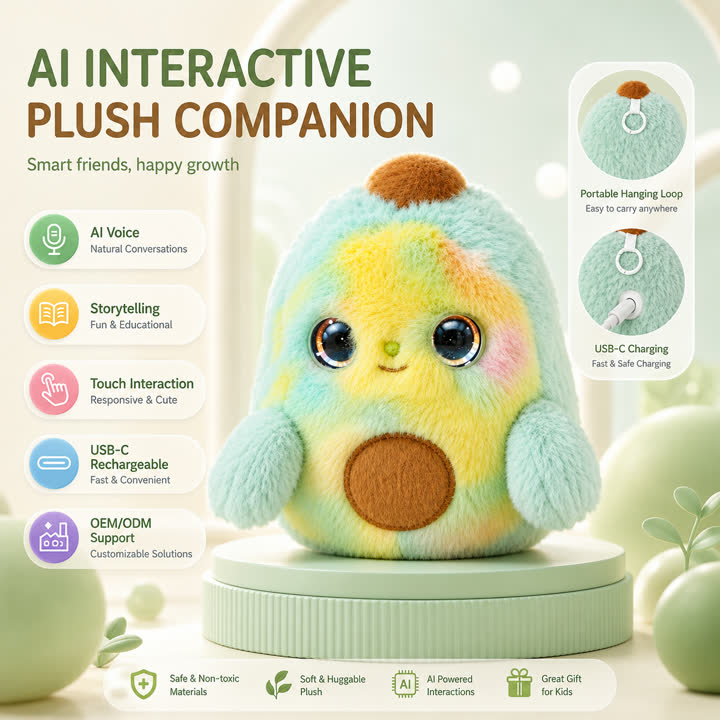
A plush toy that talks is not new. A plush toy that knows it is being carried is.
The standard interactive plush on a sourcing sheet runs on a capacitive touch pad and two or three buttons. A touch IC costs somewhere between USD 0.08 and USD 0.15, and it answers one binary question. Everything else the toy does is on a timer. It laughs every time the timer fires, whether a child is holding it or it is face down under a duvet. 📉
We build this bear with a six-axis IMU: a three-axis accelerometer plus a three-axis gyroscope. On the bill of materials it adds roughly USD 0.12 to USD 0.35 depending on the part and the calibration grade. In exchange, the toy can separate four situations that a touch pad collapses into one.
Someone left it on the bed. Someone picked it up and walked. Someone is shaking it. Someone threw it.
Those four look like product features. They are actually the difference between a return rate and a repeat order. 🔍

Image 1
TOUCH TELLS YOU THAT YOU WERE TOUCHED. IT TELLS YOU NOTHING ELSE. 👆
Picture the sequence a four-year-old actually performs. She picks the bear up off the floor, walks it to the kitchen, holds it against her chest while her mother makes lunch, drops it on a chair, picks it up again, and carries it to her room.
That is forty seconds of continuous physical contact.
To a capacitive pad, it is one unbroken high signal from second zero to second forty. The toy has no idea whether it is being cuddled, dragged by one leg, or sitting on a chair under a jacket. So the firmware does what it can: it plays a response on a timer, or on a button press that the child has to find.
There is a second problem with touch in a plush toy, and it is mechanical rather than electronic. A capacitive field reaches roughly five to ten millimetres, but it has to reach through pile. Short plush on a bear like this one is three to six millimetres deep, and the signal attenuates across it. Suppliers solve this by burying a conductive layer under the fabric, which works, and which adds a hand-stitched step on the line that nobody prices at the sampling stage.
The result is a toy where the input is a coincidence. The child hits the pad or she does not. There is nothing in between, so there is nothing for the toy to be surprised by.
SIX AXES, FOUR STATES, AND A NOISE FLOOR 📊
An IMU gives you three things at once: the magnitude of acceleration, the angular velocity, and the orientation relative to gravity. Combined, they are enough to classify what a hand is doing.
Here are the windows we use on this bear, tuned over a sampling round with children aged three to six:
Resting: acceleration magnitude holds at 1.00 g within plus or minus 0.03 g, angular velocity under 8 degrees per second
Carried: magnitude drifts between 1.00 g and 1.15 g, angular velocity 10 to 40 degrees per second, sustained for more than 600 milliseconds
Rocked: angular velocity swings 60 to 200 degrees per second in a repeating pattern at 1.5 to 4 Hz
Free fall: magnitude drops below 0.35 g and stays there longer than 120 milliseconds
Impact: a peak between 2.5 g and 4.0 g, decaying inside 80 milliseconds
The single most important number in that list is not a threshold. It is the confirmation window. Every state change has to hold for 150 to 250 milliseconds before the firmware commits to it.
That delay exists because of what households actually do. A child sitting on a bed with a bear on her lap generates hand tremor in the 10 to 30 degrees per second range, which overlaps the carried state. A parent walking past the bed edge sends a low-frequency wave through the mattress that looks like a gentle rock. Without the confirmation window, the bear wakes up and talks at two in the morning, and that is the end of the product in that house.
Sampling rate is the second decision, and it is a battery decision. Running the accelerometer at 12.5 Hz for motion detection draws around 0.6 mA. Running it at 50 Hz so the gyroscope has usable data during fast movement draws around 2.1 mA. On the 3000 mAh cell in this bear, the difference between an always-on 50 Hz profile and a two-tier profile is roughly thirty days of standby versus nine.

Image 2
THE FREE FALL WINDOW IS 220 MILLISECONDS ⏱️
Throwing a teddy bear in the air and catching it is not an edge case. It is one of the first three things any child does with a soft toy, and it is a behaviour our testing has to assume rather than tolerate.
From the moment the bear leaves a hand to the moment it is caught, the measured window where acceleration stays under 0.35 g runs between 180 and 320 milliseconds, averaging around 220 for a child of four. The firmware needs to recognise that window, decide it is a throw and not a drop, and hold a reaction ready for the catch.
We do not use zero g as the threshold, and this is where a lot of first-generation firmware goes wrong. An IMU has a noise floor of around plus or minus 0.02 g, and a plush toy sitting inside a moving car or a stroller collects vibration that pushes the reading around. A threshold at 0.2 g produces missed detections. A threshold at 0.8 g produces the opposite problem: every time an adult lowers the bear onto a bed, the hand relaxes for a moment, magnitude dips to 0.6 or 0.7 g, and the bear plays its toss-and-giggle sound at the exact moment it is being put down for a nap.
That single mis-tuned constant is the difference between a toy that feels clever and a toy that gets its speaker muted.
Impact is the other half of the same event. A landing reads as a peak between 2.5 g and 4.0 g with a fast decay, followed by 300 milliseconds of near-stillness. We use that signature to trigger a reassuring phrase rather than another laugh. It sounds like a small feature. In practice it is used more often than any other mode we shipped, because children drop things, and a bear that responds to being dropped feels like it noticed.
One more note for anyone reading this with a test lab in mind. A plush toy that gets thrown is not a defect scenario. It is a predicted use case, and the drop and seam requirements in the relevant toy safety standards are written with exactly this behaviour in mind. Building the motion logic around a throw is not extra credit. It is the baseline. ⚙️

Image 3
REPEAT AND MIMIC HAS A 1.2 SECOND BUDGET 🗣️
The mode children return to most is the one where the bear repeats what they said.
The engineering question is not whether it can, but how fast. Here is the budget we hold on this product:
Silence detection to end the recording: 400 milliseconds
ADPCM encode plus buffer: 60 milliseconds
Pitch shifting, up roughly 15 to 20 percent, to land in a child's comfortable listening range: 90 milliseconds
Playback start: 30 milliseconds
Total: around 580 milliseconds, from the child finishing her sentence to the bear answering.
We allow up to 1.2 seconds before we consider the mode broken, and the margin is deliberate. Past roughly 1.2 seconds, the child decides the bear did not understand, and she leaves. Inside 600 milliseconds, she records a second sentence, then a third, and then she is having a conversation with an object. That behaviour, not the audio quality, is what a parent describes when they recommend the toy to another parent.
The pitch shift is not a gimmick either. Played back at the original pitch, the bear sounds like it is imitating the child, and children hear that as mockery rather than conversation. Shifted up 15 to 20 percent, the same recording lands in the range a peer would use, and the interaction reads as playful.
Storage is cheap. Three seconds at 16 kHz mono in ADPCM is roughly 12 kilobytes. It lives in a RAM buffer, plays once, and is never written to flash and never sent anywhere. On a toy aimed at three-year-olds, that last sentence is a design constraint, not a privacy statement.
THE MOTION LAYER DECIDES WHETHER PARENTS KEEP IT ON 🔋
Ask a room of parents why they stopped using an interactive toy and almost nobody says it was too loud. What they say is that it started talking on its own.
Three false triggers account for most of those stories:
A mattress shifts, the gyroscope sees movement, and the laugh sound plays at 2 a.m.
The bear tumbles inside a school bag, the firmware reads a free fall, and it giggles during class
An adult carries it while walking, the rhythm matches the rock profile, and it loops a song
None of these are hardware failures. They are missing states, and fixing them is cheaper than the sensor itself.
An environment lock handles the first case. If the accelerometer shows no meaningful change for twenty minutes and no voice input arrives, the bear sleeps. It wakes only on a voice trigger or on a genuine pick-up, which the firmware defines as more than 600 milliseconds of sustained vertical displacement.
Tumbling inside a bag is separable from being shaken by hand, and the gyroscope is what separates it. Random tumbling produces angular velocity above 300 degrees per second with no periodicity. A child shaking a toy produces a repeating 1.5 to 4 Hz pattern. The signature is different, so the response should be different: in a bag, stay silent.
The third case is the one most suppliers never implement. Walking while carrying a toy produces a step rhythm in the rock band. Adding a floor of continuous forward acceleration, or simply requiring that a rock sequence start from a resting state, removes almost all of it.
Add it up and the whole layer costs USD 0.12 to USD 0.35 in parts and around three engineer-days of state machine work. Whether that pays back depends on your category and your price point, and that part is a judgement call rather than a calculation. What is measurable is what the alternative produces: a toy that responds on a timer, that parents mute in week two, and that never gets recommended to anyone. 💤

Image 4
WHAT THIS MEANS FOR YOUR NEXT PROJECT ✅
Three questions for your supplier, and the answers will tell you whether your toy has a sense of touch or a switch.
1. Can your firmware distinguish being picked up from being put down? If those two events produce the same output, every interaction your toy has is a timer.
2. What is the state confirmation window, and who chose it? If the answer is a round number nobody remembers choosing, the false triggers in the field have not been tested yet.
3. What wakes the toy up, and what puts it back to sleep? If the answer is a button, your user stops using the product in week two.
IF YOU ARE BUILDING A SMART TOY RIGHT NOW
We develop the motion and interaction layer as part of every plush program: IMU selection and mounting, state machine design, audio capture and playback tuning, and the safety file that covers dropping, throwing and seam strength. MOQ from 1,000 pieces, sampling in 3 days, tooling in 30 days.
Send me the interaction you want the toy to have and the age range you are designing for. I will come back with the sensor spec, the state table and the cost of the behaviour, itemised so you can compare it against what your current supplier is shipping.
Official Website: www.kidsoundbook.com | www.xinditai.com
Email: happy@xinditai.com WhatsApp: +8613824343309
LinkedIn: https://www.linkedin.com/in/happy-gao-education-toy-oem-odm/
YouTube: https://www.youtube.com/@XDTHappy
LET ME HEAR FROM YOU
One question for the product people.
Have you ever shipped an interactive toy that was technically working and still got muted by the user within a month? If yes, was it a false trigger, a wake-up condition, or a delay the user read as the toy not understanding? 💬
I am collecting these, because a toy that responds to a timer and a toy that responds to a hand look identical on a spec sheet. The difference only shows up in the third week.
#AIToys #PlushToys #ToyManufacturing #OEM #ProductDesign
Hot Tags: a four-year-old and a seventy-eight-year-old love the same bear. they hear different things, China, suppliers, manufacturers, factory, customized, wholesale, bulk, quotation, made in China